
This event has passed.
Wednesday, October 1, 2025
12:00 pm – 1:00 pm
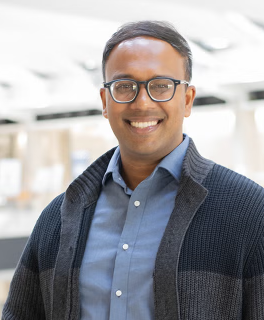
Presenter: Dr. Shwetadwip Chowdhury, Assistant Professor, Fellow of the Jack Kilby/Texas Instruments Endowed Faculty Fellowship in Computer Engineering, University of Texas at Austin
Optical imaging is a major research tool in the basic sciences, and is the only imaging modality that routinely enables non-ionized imaging with subcellular spatial resolutions and high imaging speeds. In biological imaging applications, however, optical imaging is limited by tissue scattering to short imaging depths. This prevents large-scale bio-imaging by allowing visualization of only the outer superficial layers of an organism, or specific components isolated from within the organism and prepared in-vitro. I present recent developments in our lab that design inverse-scattering methods to computationally unscramble scattering effects and reconstruct 3D refractive-index (RI) in optically thick samples. I will specifically discuss 1) novel computational microscope systems that enable high-NA, coded illumination for collecting a sample’s multiplexed scattering information; and 2) the design and practical implementation of large-scale computational nonlinear and nonconvex frameworks that enable robust RI reconstruction based on correlation analysis, digital refocusing, and low-rank initialization. Real-world bio-imaging will be demonstrated on multiple-scattering organisms popularly used in the basic-sciences. I will also discuss future research directions that can capitalize and extend these developments towards non-optical imaging, which may extend the utility of these computational frameworks to other regimes.
Shwetadwip Chowdhury is an Assistant Professor in the Department of Electrical and Computer Engineering at the University of Texas at Austin. His research interests are in developing novel optical imaging technologies for applications in science and medicine. A key emphasis in his work is the joint design of novel optical imaging systems and advanced computational frameworks to enable imaging capabilities not possible in traditional optical imaging systems. Previously, he was a postdoctoral fellow at University of California Berkeley, in the Department of Electrical Engineering and Computer Sciences. Before that, he received his Ph.D. and B.S. degrees from the Department of Biomedical Engineering at Duke University.